


Legal risks in foreign investment in Indonesia often arise from small details considered unimportant at the outset, rather than large and obvious matters. An Australian investor once described his experience: his company was established smoothly, the NIB was issued on time, and every document seemed in order. Two years later, he wanted to sell some shares to a new strategic partner. That was when he discovered that the shareholders’ agreement, prepared using an Australian format, was not fully enforceable under Indonesian law. Certain clauses considered standard in his home country conflicted with provisions of Indonesia’s Limited Liability Company Law. A share sale that should have taken weeks turned into a drawn-out legal process lasting months.
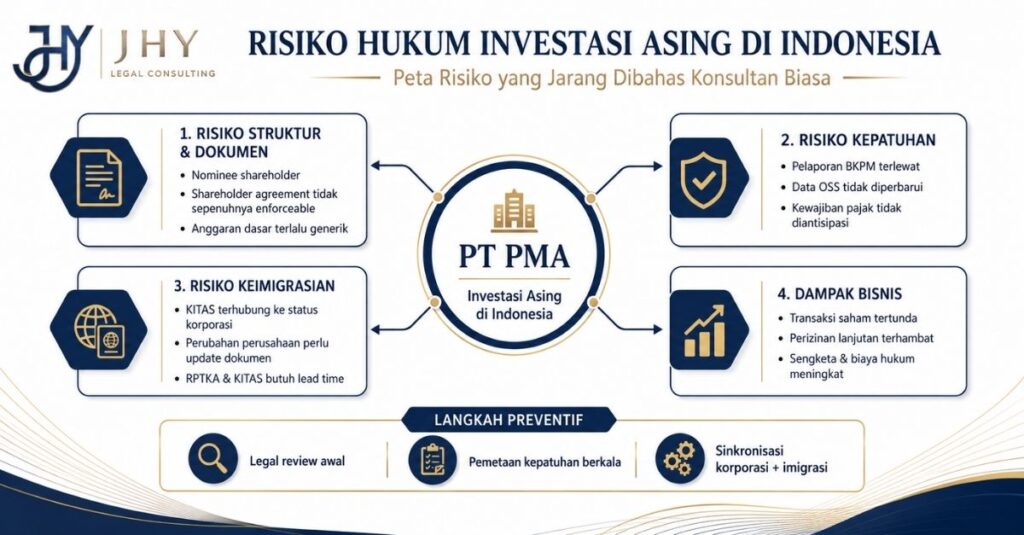
This story illustrates a category of risk rarely discussed openly by consultants focused only on administrative processes: risks hidden in assumptions, in documents that “look right,” and in questions not asked at the outset.
Frequently Overlooked Risks of Share Nominee Arrangements
One of the most serious legal risks rarely discussed candidly in Indonesian foreign investment is the practice of share nominee arrangements, where a foreign investor uses an Indonesian citizen’s name as the shareholder “on paper” while actual control remains with the foreign party.
Indonesian law categorizes this practice as a violation of foreign investment provisions. Its consequences can be very serious: cancellation of company status, revocation of permits, or criminal sanctions for those involved. The risk does not disappear simply because the practice is “common,” and consultants focused only on completing administrative processes often do not discuss the long-term legal implications of this choice.
JHY Legal consistently explains this risk to clients asking about company establishment options, because a clear understanding of legal limits is part of responsible advisory.
The Gap Between Issued Documents and Actual Protection
There is a significant difference between having complete licensing documents and having actual legal protection. Documents may be issued without difficulty, but if their substance has not been properly designed, the protection they provide can be very limited when it is actually needed.
Shareholders’ Agreements That Do Not Comply with Indonesian Law
This is among the most common gaps in PT PMA corporate structures established without adequate legal support. A shareholders’ agreement based on the legal format of an investor’s home country may look comprehensive, but clauses conflicting with Indonesia’s Limited Liability Company Law or Investment Law cannot be enforced in Indonesian courts.
Consequently, when a shareholder dispute arises, clauses the investor believed would offer protection may not have the expected legal force.
Overly Generic Articles of Association
The articles of association contain the company’s internal rules. Many PT PMA companies use highly generic templates that are legally valid but not designed to reflect the company’s specific needs. When a situation later requires a more specific mechanism, such as decision-making during a shareholder deadlock, generic articles provide no clear guidance.
“Documents that look right on the surface may conceal risks visible only when a problem occurs. When that problem arises, correcting it always costs far more than preventing it.”
Compliance Risks That Accumulate Quietly
The next type of risk arises from obligations not consistently fulfilled over the long term, rather than a single major mistake.
Missed Investment Realization Reports
PT PMA companies must periodically report investment realization to BKPM. This obligation is often not properly understood from the outset, and many PT PMA companies only realize they have a reporting backlog when applying for a new permit or undergoing corporate changes requiring a compliance status check.
OSS Data That Has Not Been Updated
Whenever the corporate structure changes, such as director changes, capital changes, or additional business sectors, the OSS data needs updating. A discrepancy between OSS data and the company’s actual position is more than an administrative issue. It can become a legal obstacle in further licensing applications or dealings with authorities that rely on OSS data as the authoritative source.
Unanticipated Tax Obligations
Some PT PMA tax obligations are not immediately apparent at establishment:
- Withholding tax on payments to foreign parties, including royalties, interest, and dividends, must be withheld and remitted according to applicable provisions, including tax treaties where relevant.
- Transfer pricing rules apply to transactions between an Indonesian PT PMA and entities in the same corporate group, requiring appropriate documentation.
- Taxable Entrepreneur (PKP) status and VAT obligations must be understood from the outset so liabilities do not accumulate unnoticed.
Immigration Risks Connected to Corporate Status
There is a risk dimension often overlooked by consultants who do not handle immigration matters: the immigration status of foreign directors or shareholders in Indonesia is directly connected to the company’s legal status.
If a foreign director’s KITAS is based on a position in a particular PT PMA and corporate changes then occur without corresponding immigration document updates, that person’s immigration status can become problematic even though they remain physically present in Indonesia lawfully.
Conversely, if the company plans to recruit a foreign director or specialist, the RPTKA process at the Ministry of Manpower and KITAS processing must begin well before the person’s scheduled start date. Underestimating the time involved is among the most common sources of operational delays in foreign corporate expansion into Indonesia.
JHY Legal’s Experience Identifying Hidden Risks
JHY Legal is a legal advisory firm focused on immigration, corporate actions, and regulatory licensing in Indonesia. We support clients in completing processes and identifying risks beneath the surface, including gaps in shareholders’ agreements, frequently overlooked long-term compliance obligations, and coordination between corporate status and expatriates’ immigration status. Our approach based on legal analysis enables us to warn clients about risks before they become actual problems.
Undiscussed Risks Still Exist, Whether You Know About Them or Not
One of the most important principles of legal risk management is that not knowing a risk does not make it disappear. An obligation not understood remains an obligation. An unenforceable clause remains unenforceable. And a problem not identified early will still emerge, usually at the worst possible time.
The most concrete step you can take is to review your existing or planned corporate structure with support from a party capable of identifying legal gaps, rather than merely ensuring documents are issued. JHY Legal is ready to help conduct that review from the earliest stage so every investment decision you make rests on a complete and accurate understanding of risk.